Shenzhen Notes: The ADIA Lab and Tsinghua SIGS Summer School
Two weeks at Tsinghua Shenzhen International Graduate School covering five concepts from photonic chips to CPU only exascale supercomputers, plus visits to NSCC Shenzhen and Pudu Robotics.
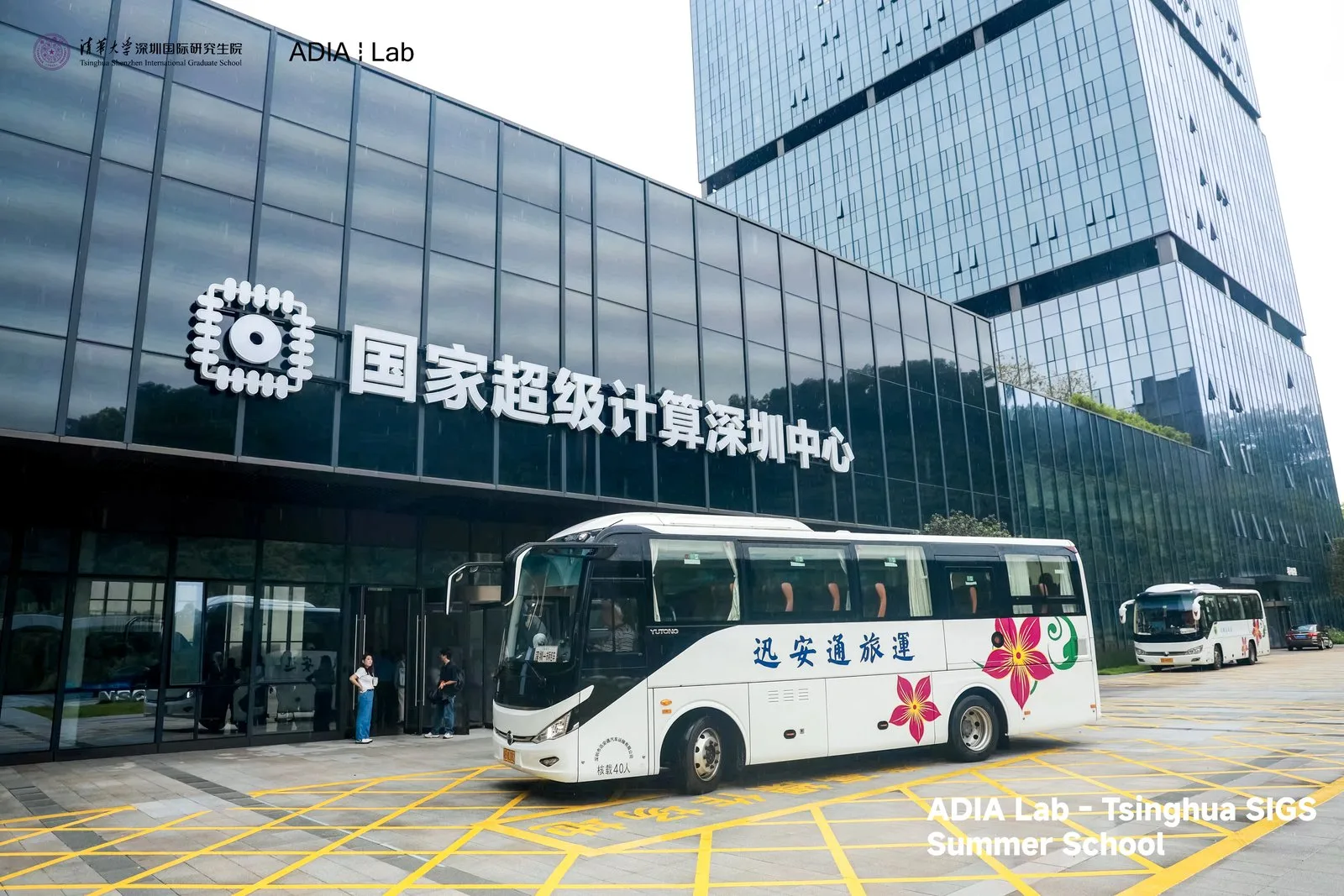
The National Supercomputing Center in Shenzhen (国家超级计算深圳中心), one of the summer school field visits.
In July 2026 I spent two weeks in Shenzhen at the ADIA Lab and Tsinghua SIGS Summer School, hosted by Tsinghua Shenzhen International Graduate School (清华大学深圳国际研究生院) together with ADIA Lab. The program covered ten lecture tracks and two site visits: the National Supercomputing Center in Shenzhen (NSCC) and Pudu Robotics. Below are my notes from the five concepts closest to hardware, robotics, and edge AI, along with what stood out during the visits. Unless noted otherwise, benchmark figures are as reported in the lectures.
Five concepts that stood out
1. AI and Optics
An optics lab at Tsinghua SIGS is pushing computation directly into light and onto the imaging sensor. Three results stood out. First, a microring photonic core reached 2.48 TOPS/mm² at 7.97 effective bits, the densest among the five designs in the authors’ table that report area density (none reports TOPS/W). Second, a flat metalens snapshot paired with a neural decoder recovered 21 spectral bands from 450 to 650 nm out of a single frame. Third, a low bit hologram network (ULBN, using 1 to 4 bit inner layers) shrank model memory from 11.5 MB for HoloNet down to 0.03 MB while improving image fidelity (PSNR 30.8 vs. 26.9 dB). A 30 KB network fits inside a microcontroller’s on chip memory. One line from the talk stuck with me: “Every imaging device is an edge AI computer.”
2. Embodied Industrial Robotics
An industrial robotics group at Tsinghua SIGS gave a refreshingly candid view of the gap between lab demos and real factory floors. They showed a live April 2026 clip of an AgiBot humanoid loading a flat panel test line, circled the arm in red, and noted that it was “shaking severely” and not yet accurate or safe enough for production. Their core argument is that factory robots need three kinds of knowledge: general world knowledge, environmental layout, and object assembly rules. Large language models only supply the first. Their compact scene graph planner, GRID (2.3M trained weights plus a frozen 1.5B text model, running locally in 0.11 s per step), reached 64.1% full task accuracy on synthetic scenes where prompted GPT 4 scored 8.0% at 2.52 s remotely. On the perception side, their IROS 2019 6D bin picking network was industrialized at Fuwei in 2023.
3. Automated Chemistry Labs
A research group at USTC presented their 3,000 m² Robotic AI Scientist Lab: 30 robots and 120 workstations open to outside users much like supercomputer hours. Users submit a research question, language model agents read the literature and propose synthesis routes, and mobile robot chemists run experiments alongside parallel simulations that feed data back into the next iteration. Humans still stay in the loop as experiment designers and machine learning specialists. One slide listed six national automated science programs, from €65M in Denmark to £2B in the UK and $1B through US NIST, alongside 19 planned or deployed “chemical twin” AI labs across China. Switzerland was not on that list.
4. CPU Only Exascale Computing
Researchers from Tsinghua SIGS and NSCC Shenzhen walked through running AI training and Earth system modeling on LineShine, the June 2026 TOP500 No. 1 supercomputer. It contains no GPUs, relying instead on Arm based LX2 CPUs with built in Scalable Matrix Extension (SME) units. In the lecture’s single node benchmark, one dual CPU LX2 node trained a transformer at 145.7 ms per step compared with 132.7 ms on an NVIDIA A100. That is about 10% slower, and at rated power (2×690 W vs. 400 W) it works out to roughly 3.8× the energy per step, though actual draw was not measured. Scaled across 20,480 LineShine nodes, their generative model compressed 652 TB of Sentinel 2 satellite imagery down to 139 GB (around 4,700×), while pushing compression to 6,000× visibly altered features like lake shapes.
5. Trustworthy Healthcare AI
A healthcare AI group from A*STAR in Singapore focused on two ideas that translate directly to embedded sensing: federated learning (“data stays, model moves”) and uncertainty estimation. When patient populations and scanners differ across hospitals, plain federated averaging (FedAvg) can score worse than training locally alone, whereas keeping site specific parameters local (FedMRI, RFedDis) recovers the gain. Once the client is a wearable instead of a hospital, federated learning becomes a hardware problem governed by memory, radio energy, and gradient leakage when updates go unprotected. For deployment safety, single pass uncertainty estimation (UIOS, 0.34 ms per image vs. 18.11 ms for Monte Carlo dropout) lets screening models route ambiguous cases to clinicians rather than guess.
Five other lectures rounded out the program: AI steered zero carbon building grids, joint building and robot design around BIM maps, clinical risk models shifting across geographies, probabilistic energy efficient AI, and export controls reaching HBM memory and EDA chip design tools.
Inside the National Supercomputing Center
The highlight of the field trips was visiting NSCC Shenzhen, home to LineShine. Placing the June 2026 TOP500 numbers beside the US GPU based No. 2 machine, El Capitan (AMD Instinct MI300A), makes the CPU only tradeoff clear:
| Benchmark | LineShine (CPU only) | El Capitan (GPU) |
|---|---|---|
| HPL (FP64) | 2.198 Eflop/s | 1.809 Eflop/s |
| HPCG (sparse, memory bound) | 22.00 Pflop/s | 17.41 Pflop/s |
| HPL MxP (mixed precision) | 7.92 Eflop/s | 16.7 Eflop/s |
| Power (HPL run) | 42.2 MW | 29.7 MW |
| Efficiency (HPL / W) | 52.07 Gflops/W | 60.94 Gflops/W |
LineShine takes the lead on 64 bit simulation and sparse solvers, while El Capitan pulls ahead 2.1× on AI style mixed precision and draws less power. Inside the center, exhibit screens list 92 compute cabinets, 47,000+ processors, and liquid cooling at PUE ≤ 1.09, alongside operator claimed speedups up to 2.5× on DeepSeek (vs. NVIDIA H20) and 5.4× on the MaCOM ocean model (vs. A100), though the exhibit publishes no benchmark methodology.
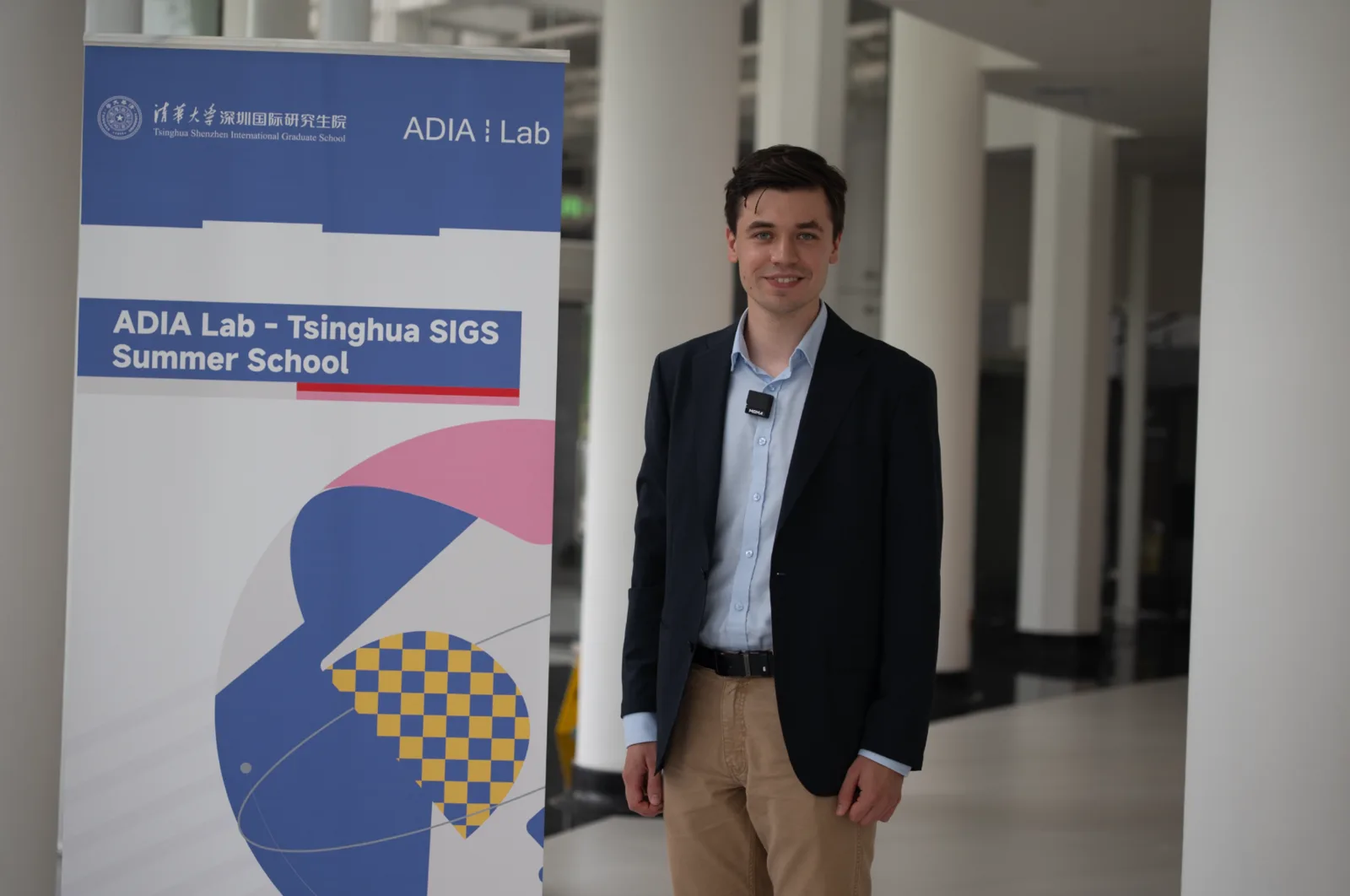 At the summer school venue, Tsinghua SIGS campus, Shenzhen
Site visit: Pudu Robotics
Our second visit was to Pudu Robotics, founded in Shenzhen in 2016 and closely connected to Tsinghua SIGS through a joint robotics research center. Seeing the showroom made Shenzhen’s lab to product loop concrete: autonomous floor cleaners (the CC1 series, with Pudu reporting that cleaning brings over 70% of its revenue and Swiss retailer Denner deploying 200 CC1 units in stores by September 2026), commercial sweepers, and the wheeled quadruped D5W (claimed 5 m/s on flat ground and 25 cm steps). Company figures cite more than 130,000 robots shipped across 85+ countries.
What I took home
- Compact, structured models keep winning when constraints bite. Whether it is a 30 KB low bit hologram network that fits in MCU SRAM or a 1.5B scene graph planner beating a trillion parameter LLM on speed and accuracy, domain structure plus compression beats brute force scale on real hardware.
- Energy and memory are the real boundary everywhere. From 42 MW exascale halls down to wearable federated learning and under 15 W automotive sensors, watts and bytes decide what ships.
- Export controls are forcing architectural diversity. Restrictions on GPUs, HBM, and EDA tools are driving domestic CPU only exascale stacks with built in matrix units (SME), echoing the CPU vs. accelerator tradeoffs we navigate in edge AI.
Thank you to CSEM for supporting my trip to Shenzhen and making these lectures and visits possible.